Showing posts with label Toronto. Show all posts

Thursday, 3 October 2013

Logged on while wallas wait in wings


It's help yourself to street food in Toronto's Little India.
My sons and I still laugh about the ‘water walla’ at the restaurant in the Little India district of Toronto, Ontario. We went there for dinner once upon the mid-1990s, tempted by the early bird special buffet deal on a winter Sunday evening.
The water walla was poised with a large pitcher less than a discreet distance from our table in the otherwise empty dining-room. Each time one of us drank some water, he pounced to replenish the glass. Our early-bird special dining experience became a cat-and-mouse game of trying to cause a distraction and surreptitiously take a sip without alerting the hired help.
By the end of the meal, we were kinked up with laughter. Yet we never went back to dine there again.
I am reminded of the water walla every time I go online nowadays. And while it is touching to know that Google, Facebook and all the other conglomerates of the ether-world are anxious to replenish my glass – while emptying my wallet, no doubt – it has become another cat-and-mouse game and this one never seems to end.
So time after time, I am proffered pictures of ‘attractive women 40+’ to tempt me into a dating website; the latest models of hiking boots to help my getaway fantasies; alluring travel deals for ‘silver surfers’; and so much more. Frankly it is getting a little embarrassing to think that a great host of online wallas is waiting to pounce on my every perceived desire and replenish my glass.
Yet I can’t seem to get up from the table, settle my bill and leave. And each time I make a choice to do something that is seemingly innocuous, another little detail of my life goes winging its way to the wallas.
The ones on Facebook are the most persistent. They now want to know where I was born, where I live now, where I went to school and every other possible detail they can winnow from the chaff of my life. Yet after several years of active Facebooking, I should think it obvious that, since I have chosen not to ‘complete my profile’, I might want to maintain some degree of discretion on the private details of my life.
I must have got lost at that point.
So if I want to take a surreptitious sip, then that is my business, not theirs.
Yet how in heck do they know so much already? Not that I have ever taken a sip from the proffered, but so obviously bogus, dating websites offering 'scores of attractive' middle-aged women near where I live (on the faraway Frontier, of course), I am still curious to know how they computed my age range. At least it saves me the embarrassment of explaining to my partner why the online Googles are offering me ‘attractive women’ of inappropriate vintage. And I suppose hiking boots are also less suspicious than other forms of apparel.
I ponder this while the wallas wait, thinking that like everything else nowadays, it probably has to do with Logarithms.
Now I wish I had paid more attention in Maths class! 

Tuesday, 23 July 2013

Dumped again in the Windy City


The attractive offer.
It’s still happening with Aer Lingus, despite the recent announcement by my airline of choice that it was inaugurating direct flights from Dublin to Toronto next year1.
Today I got another of those promotional emails offering me £40 off a return flight on its ‘USA  and Canada’ services. Having commented publicly (on Facebook) about the happy outcome of a previous Frontier Post blog about the lack of this precise service, I wanted to get in as early as possible on the fruits of my campaign2. 
So I checked it out and the price was agreeable… even attractive.
I set about placing a booking for next February. Price still OK, but then I checked the flight schedule.
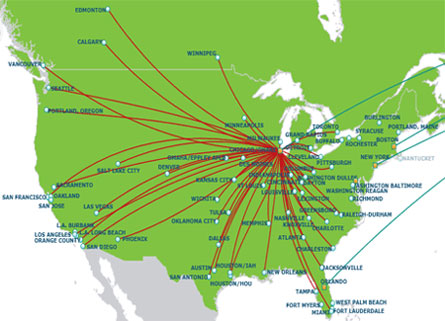
Aer Lingus was offering to fly me over most of eastern Canada and the Great Lakes into the United States and dump me in Chicago's O’Hare airport again. It would arrange with United Airlines to then take me back across the Great Lakes to Canada where I wanted to go in the first place. 
The real deal.
That’s exactly like offering to fly me from Dublin to Athens, Greece, and then dumping me in Cairo, Egypt, at the mercy of a third party airline!
It's the same on the return leg – first west on United Airlines to Chicago, then back east to Dublin! 
The duration of the flight times offered are 12 hours and 59 minutes on the outward flight, and a staggering 20 hours on the homeward flight!
Given time for all those normal departure and arrival formalities, that would extract almost two entire days for hanging around airport terminals and sitting in a flying tin tube from a two-week vacation! 
And given my recent difficulties with US Customs and Border Protection3, I would probably have to allow even more flexitime in my schedule for dealing with the ugly face of America on border patrol.
I’m sending an email reply to Aer Lingus right now asking that they send no similar offers to me until they study the map and see that Canada is not simply somewhere else on the outskirts of the Windy City… and I’m enclosing this blog post as well!


1 http://www.independent.ie/business/irish/new-aer-lingus-routes-to-san-francisco-and-toronto-take-off-next-year-29390640.html

3 http://darachmac.blogspot.co.uk/2013/04/ugly-face-of-america-on-border-patrol.html


Wednesday, 29 May 2013

Taking the long cut to Canada


It was a cryptic joke that only a Canadian could fully appreciate:
Q. How do you make the world’s second biggest country disappear?
A. Take a flight to anywhere else and then open a newspaper.
The point (for my non-Canadian readers) is that even with a land mass second only to Russia – and its strong ranking in the G8 club of leading economies – Canada is so overshadowed by its neighbour to the south that it barely impinges on the consciousness of the world beyond its borders.
For most Americans, Canada is merely the source of severe winter weather. For English people, it is a colonial theme park where the Queen goes to romp with Mounties and grizzlies. For most others, it is a paler shade of America with a lot more reserve. For the Irish, it crops up occasionally as a surprise destination for emigrants who, presumably, couldn’t get into the USA and didn’t fancy the long trip to Australia.
I know different, but then I lived in Canada for more than a decade; have been a naturalised Canadian citizen for almost two decades; and my son and daughter-in-law, along with many friends, live there.
So it is a source of constant annoyance that Irish people who are outraged when their small country is treated merely as an outpost of the larger neighbour, are so dismissive in their attitude to Canada.
Even in terms of outward perspective (on that diaspora of opportunities), this cannot be explained as merely a traditional preoccupation with Britain and America. If so, how does one explain the near obsession with Australia, which has half the population of Canada? Australia, of course, is the destination of choice for backpack ‘emigrants’ on short-term work visas. Yet even when I went there in the mid-1980s, Canada was the much more selective destination for emigrants with occupational track records seeking lifetime opportunities.
This was no ‘visa lottery’ whimsy; no take-a-chance on staying beyond the expired visitor visa; no ‘sowing wild oats’ jaunt to the far side of the world until the slump recedes. For the overwhelming majority of those who emigrate to Canada, this is the result of a rational selection of a new home by highly skilled, educated and experienced Irish people. They are going there in thousands, usually with young families in tow.
Gone to Canada and forgotten in Ireland.
Yet it isn’t just a one-way traffic either. Canada has long been the second biggest source of foreign direct inward investment in the Irish economy and it has been a major source of assistance under the Ireland Fund and other schemes that helped prime the so-called Celtic Tiger.
Which brings me to the small issue that prompted these observations. I use Aer Lingus as air carrier of choice, especially from its Belfast hubs. So I get frequent emails informing me of special offers and soliciting my business. I got one of these Aer Lingus emails today, offering me the ‘best deals’ to fly from Dublin to ‘over 70 destinations across the USA and Canada’ from as little as £205.
Wow, £205, to ‘over 70 destinations’ with my favourite airline, I thought, that’s worth checking. It wasn’t because Aer Lingus could only fly me to my choice of Boston, Chicago, New York or Orlando and then hand me on to another airline that would fly me to Toronto, Montreal, Calgary, Vancouver or wherever I might choose. Not only does Aer Lingus not fly to anywhere in Canada, it clearly does not even consider Canada a country.
Aer Lingus flies anywhere in Canada as long as it's in Chicago.
Oh, it will say that it has strategic 'flight partners', but that’s hardly the same thing as taking me where I might want to go on the unsolicited promise it made me. Instead it would be dropping me into some American airport where, no doubt, I would be harassed again by the Gestapo officers of US Customs and Border Protection (see my recent blog at http://darachmac.blogspot.co.uk/2013/04/ugly-face-of-america-on-border-patrol.html?spref=fb).
So what of the £205 fare deal? Well Aer Lingus has offered to take me on a flight path over Canada and the Great Lakes to O’Hare airport in Chicago where I can then get a United Airlines flight back to Toronto. That will take a combined 14 hours and 41 minutes – more than the flight time to Australia! Even with a tailwind on the return, by the same route, it will take 16 hours and 32 minutes. In that exhausting schedule, the £205 has suddenly become a fare of €1,619.27.
It reminds me of the joke about the Canadian tourist in Ireland who pulled up his rental car to ask directions from a local man and was told, ‘Well now, if you want to get there I certainly wouldn’t start from here!’

Monday, 8 April 2013

Ugly face of America on Border patrol


 I ran up against the obstinate paranoia of a world superpower on two separate occasions over the Easter holidays. Both times, I was amazed by the ugly bullying of smug American bureaucracy in the United States Department of Homeland Security.
The first encounter happened at the Ambassador Bridge in Detroit on 28 March. I was crossing from the Canadian side, having landed at Toronto airport after flying from Belfast via London. I was going to a conference at the University of Michigan, having been invited to deliver a paper the following day (Good Friday) on Northern Ireland 15 years after the Good Friday Agreement.
Shut up and sit down.
For the brief visit to Ann Arbor, Michigan, I was accompanied by my son, Ross, and daughter-in-law Serah, both naturalised Canadian citizens living in Hamilton, Ont. I also have Canadian citizenship since 1994 when I lived in Ontario. Yet because I now live back home, I travel on my Irish passport.
I handed over this and when asked for a US visa, I produced one I was issued in the mid-1980s, allowing ‘multiple’ entries to the United States and bearing a stamped ‘Indefinite’ for its time limit. 
I had not needed any visa while living in Canda when I made frequent crossings of the Border without incident. The officer remarked that my old visa was no long valid, having been issued almost before he was born. I would have to go ‘inside’. So watched over by armed guards, we pulled over, got out of the car and filed into the Border station.
A curt female officer of US Customs and Border Protection (CBP) standing behind a podium handed me a card form and pen and instructed me to fill it in. I did so. I handed over the card to a male officer who had taken over the podium. I was told to sit down. Several people who came in after me were dealt with speedily, including some travelling on UK passports.
Ambassador bridge too far between Canada and United States
I waited, patiently at first. I looked for direction but failed to make eye contact with any of the officers who clearly were ignoring me. Finally, my name was called out brusquely, ‘MacDonald’. I went over to a stern male officer at the part of the L-shaped counter behind where we were sitting. He asked me why I was entering the United States. I told him about the conference. I was sent back to sit down. I was called up again, asked something else, told to sit down.
Ross and Serah were called up by the officer. I rose to accompany them. The young officer barked, ‘Sit down: I want to talk to the Canadian passport-holders.’ I did so, taken aback by the hostility. I could overhear his contemptuous tone as he asked Ross and Serah how did they ‘know him?’ 
And so it continued for about an hour, called up for curt, accusatory questions, including several about my financial position, the money I had on me and my creditworthiness, then sent back to the ‘naughty corner’. All the while, I got the feeling that this CBP officer was in constant communication with somebody elsewhere who was calling the shots. At one point I was called up and had my fingerprints taken and my eyes scanned.
Soulstice 
Finally, with a Visa debit card payment of $6, I was issued a visa that would allow me enter and remain in the USA until ‘June 24, 2013’. Since it was 28 March and I only planned to be there until 30 March, I wondered but did not ask, if I would get a refund. I also felt it wise not to ask why I had been subjected to this treatment when I had a perfectly valid reason for entry. Instead, feeling like some ‘wetback’ caught wading across the Rio Grande, I slunk out of the Border checkpoint and showed up late for the conference in Ann Arbor, missing the initial registration and part of the keynote address by Professor Chantal Mouffrey of the Centre for the Study of Democracy at the University of Westminster in London.
My subsequent experience of Michigan was wonderful, the university, the city, the inn we stayed at in Ann Arbor and especially the lounge bar performance of a Motown style soul band called ‘Soulstice’. On the way back we visited Detroit, a city rising from the ashes. Everyone we met there was the very essence of friendly welcome and showed a refreshing deferential pride in their journey from US riches to ruin and slowly back to reinvention of a modern post-industrial city.
Toronto skyline – back in Canada for enjoyable Easter.
Back in Canada, without any incident at the Border, I thoroughly enjoyed Easter with Ross and Serah and visits to old friends over the following days. Then on Thursday afternoon, 4 April, I turned up at Toronto’s Pearson International Airport to check in from my flights back home. Having come from Belfast City airport via London, I was booked (through the University of Ulster) to return to Belfast International via Newark, New Jersey. I presented my passport at check-in. The officer on duty, who turned out to be another agent of US Customs and Border Protection, told me I would not be allowed into the United States because I had no visa. My $6 visa from Detroit (stamped as valid up to June 24) had obviously expired because I was told it was no longer sufficient for ‘entry’ to the United States this time.
I explained that I did not wish to ‘enter’ the United States and would only be making a flight connection at Newark airport en route to Belfast. When this drew a contemptuous scolding from the young woman about my need to comply with US regulations, I observed that I was being ‘penalised’ for using an American airline . She almost lost it at that, saying that US Customs and Border Protection does not penalise anyone and I should just shut up and follow the rules without comment. I shut up and was told I would have to apply for a new online visa approval. Then I would have to get back into one of the most achingly slow queues I have ever encountered in my life.
So with Serah’s help and iPhone, I filled in the online application form for the second time in a week, answering the same questions and queries about communicable diseases, previous convictions and political leanings, paid $16 this time, and was ‘approved’ for entry.
'Penalised' for choosing American airline for flight home.
I got back into the check-in line, which comprised only two others now. Both were almost as frustrated by the slow pace and the line of unstaffed check-in points. We waited without movement. The young Canadian woman in front was vocal in her criticism; the man behind me less agitated, but he hadn’t invested as much time so far. Meanwhile, as we stood and stared, and were pointedly ignored by the CBP officers chatting to each other on duty, those travelling on some preferential scheme were called up and processed immediately.
Finally, my turn came. I presented myself to the same officious young woman as before. She keyed in my details and seemed almost surprised I had been approved. After a stamp and a corrected scrawl, I was told I could ‘remain in the United States until 25 June’ an extra day beyond the visa I had been issued at the Ambassador Bridge a week earlier. I was then shunted through – with my suitcase still in tow – to join a separate line. Here I had my fingerprints taken and eyes scanned once more, went through the usual airport security rigmarole and made it to the flight gate without time for the coffee and duty-free browsing I had factored into my schedule.
By the time I got on board, I was in no mood for the moaning Joe in the adjoining seat who turned out to be from some Wall Street bank. He was leafing through USA Today, making insulting remarks about Ireland and the EU, along with the fiscal management of every other economy on Earth. It was too much. When he accused China and India of stealing American jobs though protectionism and cheating on subsidies, I let him have an earful. I told him about the American economic bullying I had witnessed and especially the US manipulation of the NAFTA trade deal which ‘stole’ jobs from Canada and Mexico. US capitalists wanted globalisation, I remarked, and like his Wall Street masters they had no loyalty beyond themselves, so the American jobs he lamented losing would not be coming back. He shut up for the remainder of the flight.
I barely touched the ground at Newark airport.
In the end, I barely touched the ground in Newark, landing at 7.50pm and taking off again for Belfast at 9.15pm, although I did manage to get that espresso coffee and a much-needed beer at the boarding gate. I did not have to go through passport control, where I would probably have been shaken down for another few bucks as an unwelcome interloper on American soil.
So I only bounced through America on my unwanted and unneeded second visa. It remains valid for another eleven weeks or so. At least that’s what it says in the scrawl inside the passport stamp, but I’ll not be putting that to the test. 

Saturday, 1 September 2012

Timely thoughts on coming home


The Toronto Star coverage of the story
that broke while I was up in the air.
It was a turning point in my life that began when the Air India flight touched down at London Heathrow. As we began to disembark, I felt none of the usual numbness of overnight trans-Atlantic travel. Having been upgraded (by carefully engineered chance) to Maharaja class, I was well fed, rested and revived. So as I shuffled towards the exit ramp I was alert to the conversations of fellow passengers, whispers that became more urgent as the circles of contact widened. Several faces registered shock. Out of concern and curiosity, I asked what was the matter: ‘Princess Diana has been killed.’
Over the coming hours, days and weeks, that news would consume much of the wider world, but it became just the coincidental backdrop for my life, a pointer that fixes it to a definite date in history. For that was the day I ended more than a decade as an immigrant in Canada and, after a brief stopover in London, became a ‘returned emigrant’ in Ireland.
The story of emigration is still being told.
Much has been written about emigration – most of it misinformed, maudlin or fanciful by those who can’t recognise the difference between a young, single backpacker with a smart phone and a short-term working visa and those who leave (usually by choice) with families, job skills/experience, and the guts to seek opportunities by cutting themselves adrift. Yet while the story of emigration is distorted, it is told. Little has been written about the process of coming home to a place that no longer feels like home for those who have invested a sustained effort in making a new life in their adopted country. In my case, that final return flight began a wrenching experience even if it seemed at first like the start of another holiday.
There was indulgence for my ‘Canadian’ ways, such as  little vocabulary adjustments or pronunciations, my naïve questions about life in Ireland, my constant comparisons between here and there, my confusion and doubts about the step I was taking for myself and my two children who travelled ahead while I tidied up our affairs in Canada. 
So those initial days passed in a haze. I continued to shuffle along as if the fog would lift suddenly and I would be ‘home at last’. Yet it didn’t happen that way in September 1997, no more than it had in January 1987 when I had passed though Immigration Canada in Toronto as a ‘Landed Immigrant’.
A culture shock in a Dublin taxi.
I remember several cultural shocks in those first days of return: A Dublin taxi driver whose racist diatribe prompted me to get out well short of my destination; the smug arrogance of early harbingers of the Celtic Tiger; the fixation on English soccer and popular culture by those who suggested I had compromised my identity; the bizarre bureaucracy of reinserting myself into Ireland. So as the weeks passed, I could feel my frustration grow and the sufferance of others decline in equal measure. There were fewer smiles when I ‘turned Canadian’, made a comparison, or asked a question about what others regarded as the ‘bloody obvious’ and I was challenged, ‘You know rightly why that is; sure aren’t you from here?”
I suppose those bafflements and annoyances indicate my psychological readjustment to a cultural environment that was familiar yet strange enough to befuddle. My body had been transported back across the Atlantic, but my mind was still in transit and it would take a long time for them to reunite.
Other problems were largely work-related. Having had a successful career in journalism before I left, I presumed I could re-insinuate myself into the fold. In Canada I had built another successful career in journalism, adding valuable experiences and technological skills that were only beginning to take hold in Ireland. Yet I might as well have been outside the door twiddling my thumbs for all the good that did me in the jobs market. I even felt at times that my absence was regarded as a failure and my age (mid-40s) a handicap. So I was not even called for interview when my additional skills were specified, possibly because I had not acquired them in Ireland.
Fifteen years later, I look back on those early days of uncertainty as among the most difficult of my life. I eventually scrambled back. My vocabulary readjusted and I learned not to utter comparisons that receded over time. I built a successful career for the third time in my life, but I’ve never truly settled. Along the way, I’ve written four books, and raised two sons as a single parent until they graduated from university and set off on their own lives overseas.
Canada – my adopted country.
So happy ending? Not really, because I fear the reception would be no different for returned emigrants today. When I returned to Ireland on 1 September 1997, I found a country absorbed to the point of selfish obsession about how it had changed in my absence. There was little acknowledgement that I had changed too, and exponentially in comparison. Unlike the traditional Irish emigrant’s experience of a social support network to complement institutional assistance for newcomers, I found impatience for me to deal with change alone. Unlike Canada and most modern countries built on immigration where help is available to exploit newcomers' skills, there is no agency in Ireland to help returned emigrants adjust.
There seems to be a prevailing Irish notion that emigrants are those who failed and fled and returning home just compounds the failure. I hear similar reactions from every returned emigrant I meet. And it is the ‘small stuff’ that niggles most, issues like an ease of passage for children into the education system, or getting a driver's licence (I had to pass my test for the third time because there was no ‘reciprocal exchange’).
Emigration is not easy, yet so many of us find the practical and emotional support as well as the energy to adjust to ‘living away from home’. Often we are bolstered by the excitement of a ‘honeymoon’ transition and the promise of ‘happy ever after’. Returning home is different for those who manage to find a window in complicated lives. No matter what the circumstances, returning can be like emerging from a failed marriage (and I know what that is like), with an obsessive compulsion to rekindle an old romance, then finding yourself shrugged off or simply not recognised. It is hard to find the energy in such circumstances
So today, fifteen years after I began my new life in old surroundings on the day of the death of Britain’s fairytale princess, I raise a glass to returned emigrants and wish each and every one health, happiness and a hero’s homecoming.