Showing posts with label Tyrone. Show all posts

Sunday, 11 August 2013

All eyes on the Derg


For the past week, Castlederg has been near the top of the news agenda. The small frontier town sits on the most westerly fringe of the United Kingdom, cheek-by-jowl with Donegal’s Finn Valley in the north-west of Ireland.
This was the chosen venue for the Tyrone commemoration of its ‘Republican dead’ from the recent conflict – including 53 IRA activists. The event was timed to coincide with the anniversary of the death of two IRA men from the Castlederg area who were killed when the bomb they were transporting into the town exploded prematurely.
The Republican event caused outrage among members of the Protestant Unionist Loyalist (PUL) communities as a desecration of the memory of 31 of their family, friends and neighbours killed by the IRA in the locality. They organised a protest rally to coincide with the Republican parade.
So on the afternoon of Sunday, 11 August 2013, Castlederg braced for confrontation at the Ferguson Crescent interface.
This is where the town's two virtually segregated parts meet. They are even designated by distinct names – Bridgetown, bedecked in union flags and loyalist bunting; and Churchtown, where the Republican parade would take place along Castlefinn Road and through the Catholic nationalist estates.
This is what happened!
(All photos copyright of Darach MacDonald.)


Local Protestant clergymen prepare for the service on The Diamond that was the central feature of their protest.

Republicans begin to assemble at the Priest's Lane car park.

Gordon Speirs provides musical accompaniment for the protest prayer service.

More Republicans gather at Priest's Lane.


One of the Republican flute bands arrives.

The Republican parade assembles in the shadow of the watchtower of the huge but now almost totally vacant Castlederg police fortress.

Sinn Féin, including Pat Doherty MP on left, carry wreaths. 

Republican stewards form a line across the Ferguson Crescent interface, with Loyalist stewards about 50 metres beyond them at The Diamond, with police in between.

The provincial flags of Ireland are carried in the vanguard by the parade colour party.


One of the Republican flute bands wheels around into Castlefinn Road.


The Ulster flag with its provincial counterparts.

Strabane's Republican Flute Band features two bass drummers.

Strabane fluters set off on the parade route.

The colour party of Tyrone's Martin Hurson Memorial Flute Band.

The Martin Hurson Memorial Band's flute corps.

Fluters mark time as the parade stalls momentarily.

A commotion in the background, where one Loyalist protester made an attempt to break through caused police to rush to the far line of the interface.

A Republican band from Donegal.

Tír Chonaill fluters follow their bass drum.

A Sinn Féin group from Armagh city at the Tyrone commemoration.

Another Republican band, from north Antrim, this time steps it out.

Crossmaglen Sinn Féin banner carried in the Castlederg parade.

The final Republican band, from south Derry, steps it out.


The police turn their backs to Loyalist protesters on one side…

… as the Republican parade marches off up Castlefinn Road.

Back at The Diamond, Loyalist protesters gather at the 'Cutting Edge' of the town's interface.


A parading band re-emerges onto Castlefinn Road from one of Castlederg's estates.

The colour party of the Martin Hurson Memorial Flute Band.

The Martin Hurson Memorial RFB drummers

Fluters in the Martin Hurson Memorial band.

The Tír Chonaill colour party steps along.

A young drummer flanked by his bandsmen.

Bearing along the Irish tricolour.

Flag-bearer at the end of the parade route.

The Donegal band arrives at the Republican shine in Castlederg.

The Martin Hurson Memorial RFB prepares to fall out.

Marking time on the last tune.

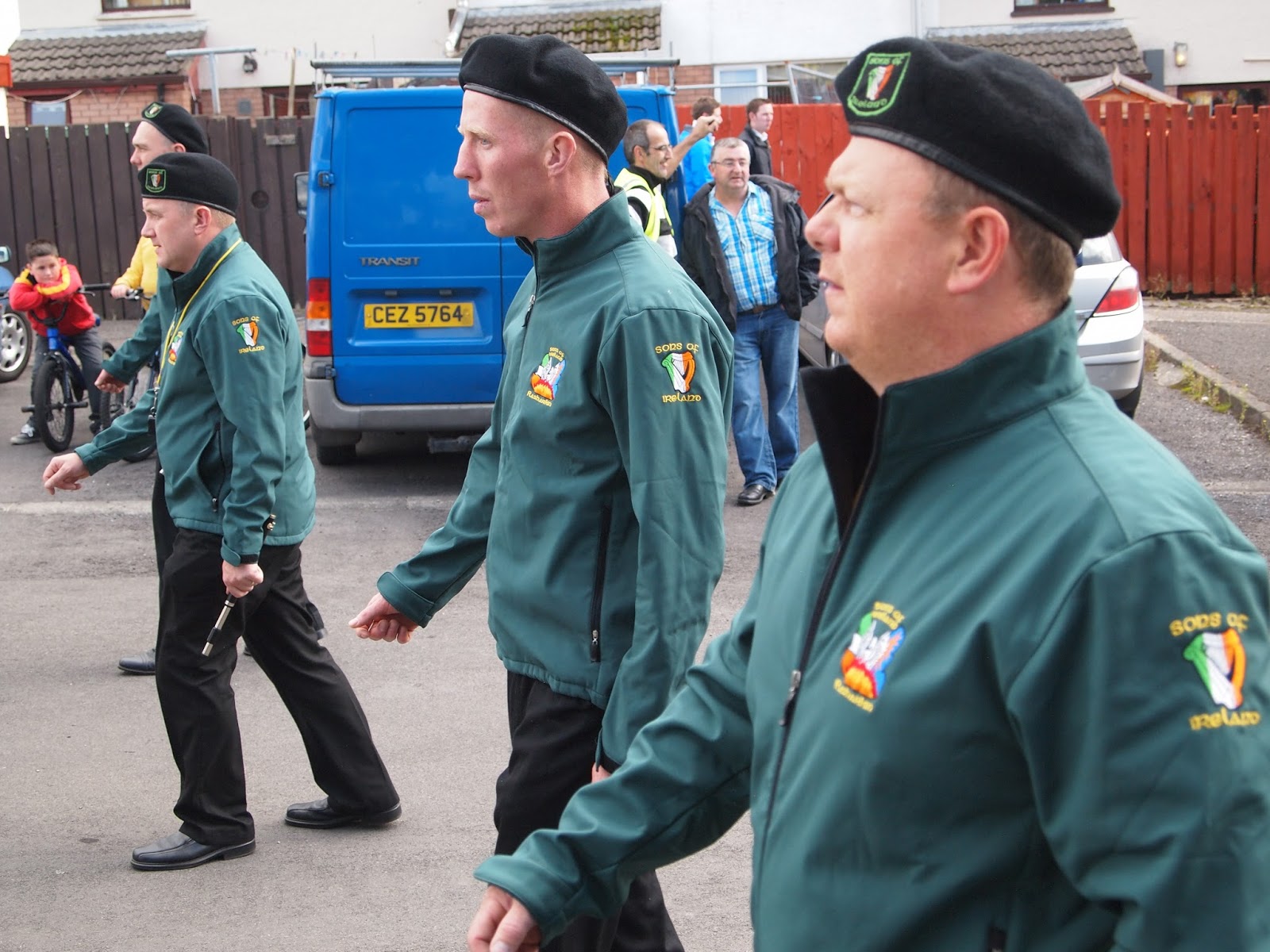
The Rasharkin Sons of Ireland band arrives.

Rasharkin fluters marching along.

One of the banners carried on the parade features 1916 heroes.

Images of local republican heroes on the wall above the shrine.

Castlederg republicans display their banners.


The colour party line up before the new Republican shrine.


Monday, 18 June 2012

The Queen and I


A cut above the rest?
Most of you will have noticed by now that I am not on the Queen’s Birthday Honours list this year. No MBE or OBE for me, much less a KBE along with actor Kenneth Brannagh (who has played in the top role of royalty before now) and the rest of the gang.
So as you negotiate your way through the alphabetispaggetti of royal rigmarole and bow or curtsy (as appropriate) to BBC Radio Ulster’s Wendy Austin and the others, I actually breathe a sigh of relief that I have escaped the British Empire once again.
Kenneth goes from King Henry to Sir Ken
(Mind you, we’ll not mention that oath for which I lined up before Kitchener Mayor Dom Cardillo in Waterloo City Hall back in 1993 when I became a proud Canadian citizen. Let’s just say there were crossed fingers behind backs as I intoned the Lord’s Prayer – as gaeilge!)
Since that day, I like to think that Queen Elizabeth II and I have had an understanding about where we stand in our relationship with each other. It is really a question of mutual indifference. Beyond wanting to keep her portrait on a few banknotes in my wallet, I don’t particularly care what she or her family get up to. I suspect she feels the same, apart from not having my portrait in her wallet, of course.
So unlike some who avert embarrassment at times such as this by saying they are not interested in, or worthy of, such royal accolades, I have never even had to feign indifference or unworthiness.
Yet with all the hoo-ha of the Jubilee, I’ve been feeling that I should come clean and confess the true reason for the fact that each time an Honours List rolls around, I can simply ignore it in the full and certain knowledge that I will not have to bow and curtsy with the other commoners, much less bend the knee for a sword-tap on the shoulder.
So here’s the secret – I don’t get on with Buckingham Palace. In fact, I am fairly certain I am ‘persona non grata’ with the palatial apparatchiks. I say this because we have had words in the past!
(Gasp! Horror! Shriek!)
It probably meant more to her at the time, but I think that our falling-out was back in 2006 when QEII was over here for a royal walkabout. There were the usual rumours, the excited gossip, a ‘possible schedule’, nods, winks and wishful thinking.
I was editor of the Ulster Herald and its sister papers back then and we were in the loop, of course, mainly because of a Royal Garden Party at the Loughrey College campus near Cookstown. At this event, the good and the ghastly of Tyrone would be expected to line up for an audience with ‘Her Majesty’ and it was all ‘hush hush, nod, wink…’ and all that Monty Python stuff.
This is a 'VIP'
I wish I could describe how excited I felt about being invited, but that would only be a lie. Of course, I did not want to appear ungrateful, so I used the invitation for a short news item in the Tyrone Herald about the pending event. The only change was that I substituted the notification of a ‘VIP” presence for the fact that Queen Elizabeth II would be in attendance – just as the entire county of Tyrone and surrounding districts knew.
The event passed without undue attention or mishap. I was not even missed. Then a few days later, I got a call – several calls, in fact. First from the Northern Ireland Office, which assumes precedence in such matters of state business. It was a rather curt rebuke for ‘breaking protocol’ by naming the ‘VIP’.
I fear I was less than suitably contrite: I seem to remember laughing.
But that was only the beginning. Subsequently, there was a call from Buckingham Palace, a plumy voice announcing a name or title I could not decipher with my simple commoner hearing. I proffered my excuse about the ‘dogs in the street’, but to no avail. My refusal to prostrate myself in abject apology brought the royal pronouncement that the Ulster Herald group and I would be banished from the realm of garden tea parties and press statements about ‘VIP visits’ for the foreseeable future.
There was no mention of OBEs or MBEs and I thought it would only make matters worse if I put in the ‘wee word’ for a Knighthood, so the call ended in silence. And that was my Royal flush.
She’s getting on now – QEII – and I suspect that this falling-out might be rankling a bit with her. But I hold no grudges and sure, if she’s ever back in Tyrone, she’s more than welcome to drop by for a cuppa, a wee dram or just a chat … so long as it’s not about any bloody empires, of course!

Thursday, 8 March 2012

Lost for names in time and place


‘I never saw a richer country, or, to speak my mind, a finer people; the worst of them is the bitter and envenomed dislike which they have to each other. Their factions have been so long envenomed, and they have such narrow ground to do their battle in, that they are like people fighting with daggers in a hogshead.’ – Sir Walter Scott, 1825

Tourist board gets it ass-about-face on the locaton of the Clogher Valley Show
 Ireland, it has been noted, has far too much history and simply not enough geography. Yet what ‘narrow ground’ we inhabit, we envelop in multiple names that confound and confuse visitors, while we inhabitants misname, rename, relocate and forget. 
So long before this age of dwindling assets, we had trouble keeping track of our real estate. And much of it stems from simple carelessness.
Take, for example, the case this week involving the Northern Ireland Tourist Board (NITB), which hardly has a limitless domain to promote by any stretch of the imagination. It placed an ad in the Belfast newspaper, The Irish News, proclaiming, among other events, the attractions of the Clogher Valley Show scheduled for August in the village of Augher. 
In the process, it moved the venue from County Tyrone to County Fermanagh, a not infrequent mistake for Belfast-based bodies when it comes to that proud locality. Fivemiletown on the western fringe of the Valley, and also officially in Tyrone, is invariably assigned to Fermanagh, although the Tyrone-Fermanagh county line does actually run through the button roundabout at the junction of Main Street and Clabby Road.
Wendy Austin
Wendy Austin, host of Talkback on BBC Radio Ulster, took up the NITB’s Clogher Valley faux pas. While wagging the finger at the NITB, she then admonished a couple of Fermanagh people for not knowing where the village of Plumbridge was. Sure didn’t they go through it on their way to Belfast? Wendy was obviously unaware that going through Plumbridge – in the very heart of the Sperrin Mountains of north Tyrone – would entail a detour of more than 100-km from the Fermanagh to Belfast A4 route. That of course would take them perilously near the city of Derry/Londonderry and even closer to the village of Dunamanagh/Donemana.
Let's shake on Derry/Londonderry
 Yet place-names remain at the very core of our identity on an island where the smallest unit of officially named geography is the townland, a space ranging from a couple of hectares to broad expanses of moorland.
We have long sparred across and inside our two jurisdictions of multiple names. Dublin governments and their subjects have been affronted down the years by the use of ‘Éire’ to designate their state in English, even if it is the proper title in the first official language. 
In a similar vein, those who have even shrugged off the Republic of Ireland designation and now style their 26 counties as ‘Ireland’ in all official communications, as well as in the name of their soccer team, regard the use of the ‘Free State’ by northern nationalists as a knuckle-dragging insult.
Rockall – another disputed territory.
In their enthusiasm for a truncated Ireland, it often seems as if they have managed to create an extra 420 kilometres of coastline and floated the six other counties of Ireland off to somewhere near Rockall, another piece of real estate that has caused bother in the past.

Yet it is hardly better on the northern side of the boundary line, where great passion can be invoked by what people call the place. Unionists once proclaimed their jurisdiction as Ulster, persisting in the delusion that they had honoured the Solemn League and Covenant of 1912 by simply obliterating the counties of Donegal, Monaghan and Cavan. More recently, they have reverted to the official designation of Northern Ireland. The use of the alternative ‘North of Ireland’ is now pounced upon as a pejorative insult used disparagingly by nationalists and republicans who were previously denounced for using 'the Six Counties' in all references. Yet for many decades, the ‘North of Ireland’ was used as frequently as ‘Northern Ireland’ by unionist spokesmen, although both names fell far behind ‘Ulster’.
Supporting 'Our Wee Country' aka 'Norn Iron'
(Indeed, common international usage in place-names would suggest that the occasionally heard Americanism ‘North Ireland’ is more appropriate for a defined separate jurisdiction, as opposed to an internal region with less defined boundaries, as in North Korea, South Africa, North Dakota and southern California etc.)
So while Republic of Ireland soccer fans proclaim their allegiance to ‘Ireland’, their fellow football enthusiasts supporting the team of the original Irish Football Association get over this legalism by embracing the diminutive virtues of ‘Our Wee Country’ and chant the reminder that they are ‘not Brazil’ but 'Norn Iron'. Thankfully, fans of all other sports in international competition do not experience this problem.
But our confusion over what to call places is not confined to our own ‘wee island’. While many Irish people bristle and fume at the use of the accepted geographic descriptor ‘British Isles’, they have taken to increasing use of ‘the UK’ to describe the biggest neighbouring island in our ‘north-west Atlantic archipelago’ – the island that we once called ‘Britain’ or even named by its constituent parts of England, Scotland and Wales, before Maggie Thatcher undertook to put the 'Great' back into it.
The UK acronym stands of course for the United Kingdom of Great Britain and Northern Ireland, yet that meaning is only conveyed publicly in statements – mostly from unionists – wishing parity of esteem with ‘the rest of the UK’. On this island, southern business commentators and others will often refer to situations applying in ‘the UK and Northern Ireland’ as if they are separate places.
The UK designation grows more precarious in the 21st century, of course, given the Scottish propensity for scrapping the original union forged in 1707 and into which our island was drawn almost a century later, with revision after another century to accommodate the creeping formalities of Irish partition.
Yet our name-calling persists in defying politics, geography, law and even history. The Frontier Post has dealt in a previous blog with those who extend the longevity of partition back into the 19th century. One prime example of this nonsense was from the historian Ruth Dudley-Edwards.
Barbary pirates raided Baltimore
She is not alone we found this week. On Sunday, the usually excellent evening slot on RTÉ Radio 1, The History Show, featured a fascinating segment on the ‘Sack of Baltimore’ on the Cork coast in 1631 by pirates from the Barbary Coast of Africa. The History Show host Myles Dungan observed that such raids for slaves were not confined to Ireland. They also occurred at that time (1600s), he told us, on the southern coast of ‘the UK’!