Sunday, 18 March 2012

Peace survives Loyalist bands celebrating St Patrick's Day


On 17 March 1762, some Irish-born soldiers serving in the British Army in the American colonies formed ranks and paraded to church in New York in honour of St Patrick. They probably had drums, banners and flutes (or fifes). It is unlikely that they had Mardi Gras costumes or floats and they certainly had no tricolour flags.
That was the first recorded St Patrick’s Day Parade.
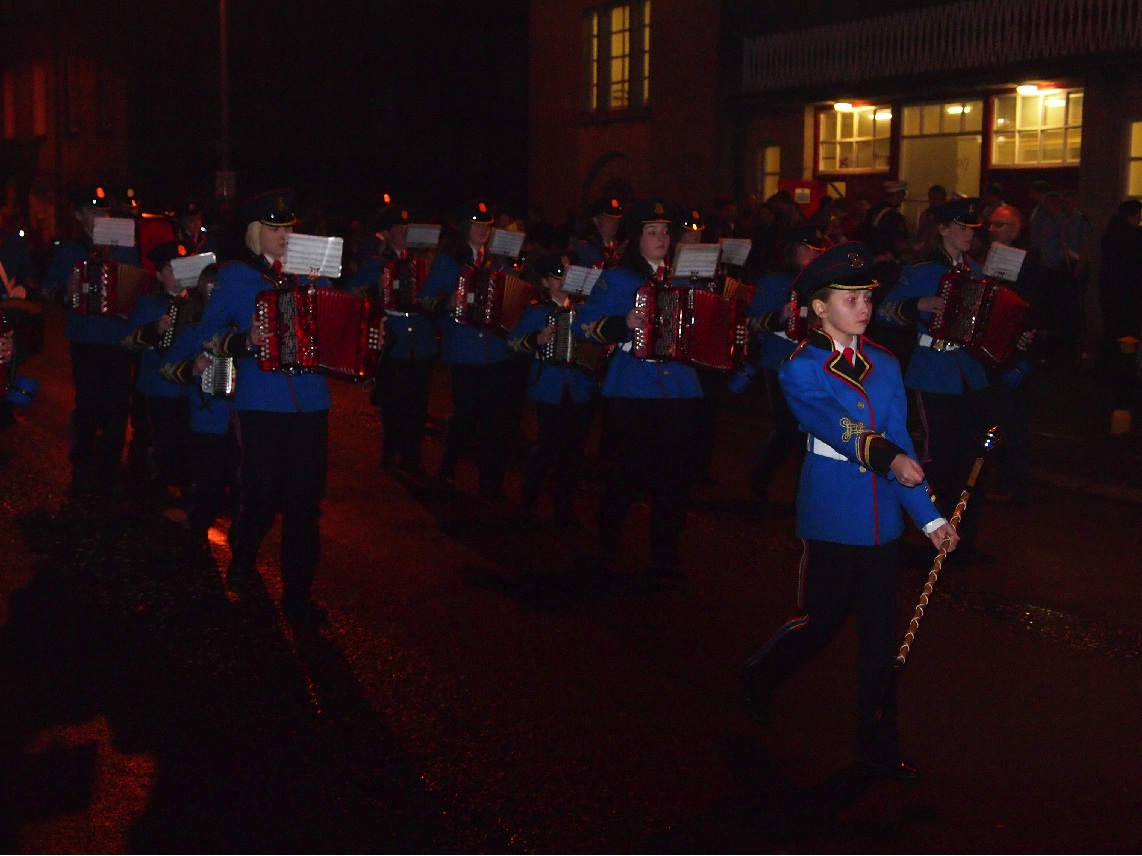
Two-hundred and fifty years later in Armagh last evening (17 March), more than a thousand young men of military age – and some young women too – formed ranks and marched through the ecclesiastical city of Patrick to the brattle of drums and the sound of flutes. They played Irish jigs and traditional military airs including Tipperary and Killaloe. Most of them were dressed in military-type band uniforms.
A total of 40 guest bands joined the Cormeen Rising Sons of William Flute Band in the annual St Patrick's Day Parade which until now was held in the small village of Killylea, about seven miles from Armagh City.
To accommodate the growth of the event and stake a claim to the patron saint shared by all Christians in Ireland, this year the band changed the venue to their local city. The parade application was considered and approved by the independent Parades Commission, subject to certain conditions with which the bands readily agree to comply. 
Politicians from the national/republican tradition warned of serious trouble if the parade went ahead. They condemned it as provocative and seemed to imply that the Cormeen Sons should have stayed in their Border village where their annual parade in celebration of St Patrick has been studiously ignored for years.
Yet a few hours ago in Armagh, I saw families and band enthusiasts enjoying a traditional St Patrick's Day band parade that is now established as the first event in a busy season of events involving hundreds of bands and thousands of band members.
There were no tricolours, of course, but that does not make this any less an Irish tradition. Indeed, the spectators who lined much of the route, especially around the spectacular Mall at the heart of the city, were only waving St Patrick's Cross flags.
The event passed off peacefully and well before the 10.30pm deadline imposed by the Parades Commission.The world didn't end and there were no riots or confrontations. The peace process held and those present had a great evening out.
I do not come from the Loyalist tradition, but over recent years I have learned much about the huge importance of marching bands for Ulster Protestants. My book, Blood & Thunder: Inside an Ulster Protestant Band (http://www.mercierpress.ie/Blood_And_Thunder_Inside_an_Ulster_Protestant_Band/504/) tells the story of a year I spent with the Castlederg Young Loyalist Flute Band. Last night, I met some of those young Castlederg bandsmen who had come along to enjoy the parade, even though they weren’t taking part this year (because of a wedding). It  was good to enjoy a bit of banter with them and see that they are clearly excited by the start of a new band  parading season.
Meanwhile, I was hugely impressed by the success of last night’s celebration in Armagh; by the way that the band and the local Armagh Bands Forum handled the issue; by their willingness to talk and engage with  representatives from the other tradition that the Orange and other loyal institutions won’t countenance; by their concern for their ancient ecclesiastical city and community; by their insistence that they will not be discounted from claiming their own Irish heritage.
The peace process was enhanced, not damaged, by this year’s St Patrick’s Day Parade hosted by the Cormeen Rising Sons of William. Last night, thousands of Protestants – many of whom openly said they had not been to a parade for some time – celebrated their stake in Ireland and its cultural heritage by showcasing their tradition of military-style marching bands.
They found a reason to be proud to be Irish according to their own Ulster Protestant traditions and a magnificent occasion to express it inthe way to know best. We should all be grateful for that.




Wednesday, 14 March 2012

Laying claim to Patrick and parades


It was a village parade on the evening of St Patrick’s Day, a family celebration with marching bands, lilting music, colourful costumes and a shared aim of honouring Ireland’s Christian patron.
If it differed from other 17 March processions that day, it could have been because it was bigger than most with dozens of bands playing jigs and dance tunes in march time as they completed the parade circuit.
Or perhaps it was because there was such strict order in the proceedings, tight discipline in the ranks, careful marshalling of participants and onlookers, and no signs of rowdy drunken revelry even among the small groups gathered around the doors of the two pubs at the top of the village.
I was there on that 17 March night in 2009 and I wrote a detailed description of it in my book, Blood & Thunder: Inside an Ulster Protestant Band.
Oh, that was another difference from all the other parades covered by the local, regional and national media. It was the annual parade organised by a Loyalist marching band, the Cormeen Rising Sons of William, in the small village of Killylea, outside Armagh City.
It was the first Loyalist marching band parade I attended that year, the recognised curtain raiser for similar local band parades that dominate the lives of band enthusiasts in the Ulster Protestant community – on both sides of the Border – right through until October. A similar St Patrick’s Day parade with dozens of Loyalist bands is held in Coleraine.
Conor Murphy MP
The Cormeen Sons are organising their parade again this year and, because it will be bigger than ever, they decided to switch the venue from their small Border village to their small local city. Their opponents are affronted.
Local Sinn Féin MP Conor Murphy calls it a ‘disaster’ and says it should have been a ‘no brainer’ decision for the Parades Commission to ban it completely.  He dismisses the police finding that there is no local concern about the parade.
Following in the footsteps of British soldiers who initiated a parade to honour St Patrick
So what is the problem exactly, apart from the fact that this will be a tightly controlled celebration of St Patrick by Ulster Protestants who have long said they do not feel comfortable with the appropriation of St Patrick for what has become a ‘nationalist celebration’?
Some of them even argue, with justification, that their parade in honour of St Patrick is closest to the original – the parade by British army soldiers through the British colonial streets of New York on 17 March 1762, an event now appropriated by the Ancient Order of Hibernians!
The Loyalist bandsmen are far from strident, appealing for calm and reason.
It is not as if they plan to take over the streets for their occasion. The Cormeen Rising Sons of William applied many months ago to host their celebration in Armagh City; filed the appropriate notification with the Parades Commission; provided details of participants, route, likely attendance, marshalling arrangements, start and stop times; and they even augmented all this with professionally prepared commercial and community impact assessments.
When the Parades Commission sought changes, they complied without protest. They also gave a firm commitment to abide by the Parade Commission’s final decision no matter what that might be.
Nationalists: Acceptable enjoyment on St Patrick's Day?
Loyalists: Unacceptable enjoyment on St Patrick's Day?
Heck, the Cormeen Rising Sons of William even issued repeated invitations to Sinn Féin and the SDLP to talk with them, so that they might allay any fears about their motives or arrangements.
In extending the invitation, the band reminded Sinn Féin of its own Charter for Unionist Engagement. So while the SDLP fulminates in private, the band accompanied by local DUP MLA  William Irwin, met Sinn Féin in Armagh City this evening (Wednesday). Afterwards, the band isued the following statement: 'Regretfully no agreement could be reached. Sinn Féin's sole proposal was the exclusion of the event from the city on St Patrick's Day. Exclusion has been the root cause of many of the communal problems in Northern Ireland over the past decades, and we feel to reignite another cycle of that nature would be irresponsible.'
However, the Cormeen Rising Sons of William added, 'We have, however, taken the apprehensions of Sinn Féin on board and will make extra efforts to ensure the procession passes peacefully.
'The way forward to a shared future is acceptance of each other's cultural practices and traditions. We would sincerely urge all those in Armagh on Saturday to exercise mutual respect for each other and not repeat mistakes of the past; mistakes which have benfitted no-one.' 

So what will happen on Saturday? The Loyalist band world is buzzing with rumours of republican protests being organised. Republicans are affronted by what many of them see as a bid by Loyalists to ‘hijack our holiday’. Despite claims to the contrary, many still clearly believe that suppressing and bullying another culture is the best way to earn respect for theirs, and no decisions by the Parades Commisison should count except those for their side. Even in an episode that seems to fit perfectly with the ideals of parity of esteem, hands-off adjudication by an independent body, cross-community dialogue, face-to-face encounters to air and settle greviences and clear commitment to community peace, the parade is opposed by what seems to be a dog-in-the-manger insistence that it is 'provocative'.
But even so, the bands are getting ready to celebrate St Patrick in his own city with the parade setting off around 7pm on the route from Mall East through Gaol Square, Barrack Street, Scotch Street, Market Street, College Street and ending up on the West Mall.
Quincey Dougan
‘The band will fully comply with the (Parades Commission) determination on Saturday evening, and will be working with the PSNI to ensure it is an enjoyable and trouble free evening for all,’ said spokesman, Quincey Dougan, who is also a highly popular weekly columnist on the culture and proceedings of marching bands for the Belfast daily newspaper, the News Letter.
‘St Patrick is the patron saint of all of Ireland and all of its people,’ Quincey reminded us all. ‘We fully respect the rights of others to celebrate according to their own traditions, and in turn would ask that they respect ours.’
And my plans? Oh, I’ll be in Armagh City to enjoy another annual parade of the Cormeen Rising Sons of William and I'll enjoy seeing our other great Irish cultural tradition honour the patron saint we all share.

Monday, 12 March 2012

Where murder and mayhem lurk…


Hands up, you're in the South now
As we drove back across the Border at Lenamore, my friend seemed to exhale a sigh of relief. The once-forbidding outer reaches of the Steelstown and Galliagh suburbs of Derry city were a welcoming haven now, he said.
He was joking, of course, but with more than a hint of ironic truth
‘I’ve told friends in the South that I’m getting too nervous to visit them now,’ he said, 'because all I seem to read about is violence and murder.
‘At least when that was happening up here, we sort of saw the reason for it. We could even avoid it and live our lives in relative safety. Down there, it just seems senseless and random and it’s as bad as ever it was up here.'
I decided to keep a tally. Today (12 March), it includes the following:
• A decomposing body – thought to be that of a young man who was murdered last summer – unearthed from a bog in north Kerry;
• A member of a military bomb disposal squad injured while making safe an improvised explosive device (IED) fixed to the underside of a car in Cork;
• A warning by a local politician that the proliferation of knives has led to a wave of seemingly random attacks in Dundalk.
The body from the bog was a chilling reminder of the continuing search for the ‘disappeared’ victims of the Troubles. Combined with the under-car bomb, it harked back to the legacy of a 30-year conflict in Northern Ireland, an era we are still working to put behind us forever.
Gardaí gather at another crime scene
But on my trawl for news of violent crime south of the Border, I could have gone back for the past month and compiled daily incidents of violent crime, a recurring catalogue that matches some of the worst of the Troubles.
It would include the shooting of four men, two of them fatally, near a GAA clubhouse in Kildare; a drive-by shooting in suburban Dublin when stray bullets narrowly missed a group of innocent teenage girls; the discovery of two bodies, both with fatal gunshots, in separate cars in rural Roscommon; and the corpses of two men, both shot, in a burnt-out car dumped in isolated Ravensdale Forest just south of the Border.
It is a chilling reminder of former times, yet such wanton violence seems to have become almost an accepted aspect of life south of the Border. When it was happening up north, there was natural alarm that it could spiral out of control and even infect the south in its mindless mayhem.
Back then, people from Dublin and points south visibly quaked at the prospect of crossing the Border. Truth to be told, some still do.
Yet the fact is that the recorded level of violent crime in Northern Ireland last year was the lowest since the start of 1969. Let me say that again, the violence has dropped to the level it was before the real onset of the Troubles and the start of the IRA campaigns.
That was back in the relatively innocent days when Dublin and all of Ireland was agog at the grisly case of medical student Shan Mohangi convicted of killing his 16-year-old girlfriend in a botched home abortion. That notorious story began in 1963 and rolled on for years. Today, it would be a mere blip on the screen of public consciousness, kept alive only by the True Crime industry.
Living in the dark Underworld of 'Jerry Lynch'
For it is a relatively new feature of journalism south of the border that Crime Reporters are top of the heap. They churn out a seemingly endless diet of murder and more, salivating over the details, weaving it into the fabric of ‘what readers want’ and conveying it with all the self-serving certitude of their police informants. It’s like an endless reel of the cult movie Intermission, with Colm Meaney’s over-the-top detective character ‘Jerry Lynch’ directing all the action.
Twenty-five years ago, Dublin newsrooms had ‘Security Correspondents’ whose main job was to monitor and report on the spill-over of violence from the North. ‘Indigenous’ violent crime, not connected to the North, was rare and largely played down by the police because it happened in marginalised and impoverished working-class communities.
Yet the onset of the peace process brought a commensurate rise in the level of ‘crime reporting’. Today, Dublin’s coterie of ‘Crime Reporters’ form a new hierarchy in the industry. They combine into a new breed of reporter that specialises in bated breath, in-your-face eyewitness accounts, delivered with all the brashness of Hollywood goodfellas. The violent murder of their role model, Veronica Guerin, hardly brought a pause in their early gallop and they have now become the self-fulfilling prophets of our age.
Today, many of them even double as writers of churned-out popular crime fiction eagerly sought by publishers to supplement the diet of voracious readers and whet their appetite for the next instalment of reality. It is also noteworthy that among the new flush of crime novelists, the talented teacher from Derry Brian McGilloway focuses his fiction across the frontier in Donegal, an otherworldly Underworld of the imagination that is increasingly styled ‘Borderlands’, as if it was one actual place removed from the real Ireland.
Rupert Murdoch
Meanwhile, other crime reporters specialise in cut-and-paste books of their most salacious offerings for a regurgitated feast of sickening stand-out stories. And just in case you missed it all, there are ‘dot.ie’ websites dedicated to listing news of crime.
It is an endless carousel of crime that begets crime and we can’t even blame the evil empire of Rupert Murdoch who has little control over Dublin’s media machine.
So do I propose censoring news of crime?
Certainly not, but I can’t help feeling that the ascendancy of these Underworld overlords in our news industry has been at the expense of real news gathering, of competent hard-slog journalism that would focus on more than the sensationalised symptoms of a sick society.
Let’s disregard the endless repetition of that police lexicon of ‘thugs’ and ‘villains’, blaming them alone for spiralling violent crime.
Focus instead on the overwhelming majority of people in these marginalised communities who know themselves what can and cannot be done to improve their lives and the prospects of their children.
Let’s step back and resist ‘shock and horror’ for what many news editors would deem ‘boring angles’.
Let’s conduct a reasonable debate about the ‘criminalisation’ of drug addiction that feeds the twin maws of criminals and a ‘law and order’ cult.
Who knows, we might even reverse the seeming inevitable slide into crime as normal.
Non-political crime was once largely in the realm of TV drama
It happened up here with a lot more baggage to carry along and it can happen down there if society resists the dark world of ‘law and order’ doomsayers, and reassesses its values from a fixation with crime to a real focus on caring for ‘all the children of the nation’.
Meanwhile, I’ll probably be watching my back when I cross the Border. For as they used to say on Hill Street Blues, back in those halcyon days of the early 1980s when non-political crime was mostly the fare of American TV soap operas, ‘Let’s be careful out there.’

Saturday, 10 March 2012

Everyone gets a vote…except us

Bringing in the votes on another offshore island
HER Majesty’s Secretary of State  for Northern Ireland has no intention of allowing us to have a say on the issue of partition, as provided under the Good Friday Agreement of 1998.  Last Wednesday (7 March,) Owen Paterson told the British House of Commons that he hadn’t received ‘a single letter or phone call’ asking for such a vote.
Owen Paterson
Paterson must not have been listening last month when Northern Ireland’s Deputy First Minister Martin McGuinness called publicly for a referendum on the Border and even suggested that 2016 might be a good time to have it.  Perhaps our political overseer regards such widely reported public utterances on this side of the Irish Sea as being about as reliable as a ‘bogus Tweet ‘to RTÉ’s Pat Kenny.
However, McGuinness’s suggestion of a Border poll was welcomed by unionists who are confident of victory for the status quo on the basis of recent opinion polls. The DUP’s Nigel Dodds says 80% of people in Northern Ireland want to stay in the UK. Leading unionist commentator Alex Kane even urged the British government to ‘bring it on’ in his 13 February column in the News Letter.
The Secretary of State must not have read his copy of the News Letter that day either.
Little wonder, therefore, that Sinn Féin President Gerry Adams described Paterson today (10 March) as  ‘not one of the most adroit or skilful’ Secretaries of State dispatched from Westminster to keep us in line: ‘Quiet down there at the back of the class! I’m not listening to a single word you’re saying!’
Letters and phone calls to our political overseers notwithstanding, the idea of a plebiscite on partition is never far from the surface of public discourse here. Most outsiders seems to believe we are fixated on the issue. So why do we need permission from Paterson or anybody else to address the question formally when any ‘smart Alex’ can set the date and even the question for Scots to tell England and Paterson’s Tory party where to go?
The Scots are straining at the bit for their referendum in 2014, while our polite  suggestion that we might have a vote two years later is met with a cursory caution to get back to our desks and don’t move until I say so.
It seems unfair, because compared to the Scots, we have more form on airing our views about the Sasanachs and their propensity to treat us like unruly children.
Stormont Assembly – sharing power, taking sides
Yet outsiders could be forgiven for thinking that every time we go to the polls in Northern Ireland we are casting votes for and against the Act of Union.  For the results of every election – from Westminster  parliament, to Stormont Assembly  to local councils – are interpreted as indicating the balance on the Border.
Notwithstanding the seemingly inexorable rise of Sinn Féin and the erosion of influence by Paterson’s erstwhile UCUNF allies in the Ulster Unionist Party – which is shedding its third leader since the Good Friday Agreement – the Union looms large in our lives over here. Just about every single act appears to indicate one’s views on the Border.  Where we live, go to school, shop, take a  short-break holiday, play or support sports and individual teams, and even what we call the political entity  in which we live,  reveal views on partition.
Never mind opinion polls, we are living the plebiscite daily . So who has time to write a letter or make a phone call to Owen Paterson?  Who even knows the address or phone number for his North Shropshire constituency office in England?
Yet when it comes to putting our ‘X’ where our mouth is, or listing our constitutional options in order of preference, it seems we must wait patiently while Her Majesty’s Secretary of State  deals with more pressing problems.  And those do not even include showing up for a debate  in Westminster Hall on reviving the Northern Ireland economy. Instead, Paterson showed up in the Commons with a fake Irish accent on Wednesday to tell a yarn about a soldier in the 87th Irish Foot who seized the standard of the French imperial  eagle in a Napoleonic Wars battle in March 1811:  ‘Bejesus I have the cuckoo!’  If the House hadn’t been almost empty, he might have been hauled up for racist  mockery.
But back to the Border and the chances of a ballot.  Given that everything we do seems to be taken as a declaration of how we would vote,  outsiders might wonder why we even need a formal referendum at  the pleasure of Her Majesty’s Secretary of State. One reason might be that we’ve never actually had a vote -off on the issue in the ninety years of Northern Ireland’s existence.
Boundary Commissioners Fisher,  Feetham and MacNeill in Armagh 1924
Partition was implemented in 1922 when the Dáil  voted for the  Anglo-Irish treaty.  Under Article 12,  a Boundary Commission  was to decide the eventual  lay of the land and both sides suspected, with reason,  that this would render Northern Ireland inoperable. Then a leaked disclosure of an unfavourable outcome  prompted Dublin to do a behind-the-scenes deal copper-fastening Unionist control of the six counties  in exchange for wiping out  its share of the Imperial War debt  (which would probably not have been paid anyway). 
So after 50 years of two sectarian states ,Britain decided we should have a vote – bizarrely called a ‘sovereignty referendum – at the height of the Troubles in  March 1973.  It was boycotted by nationalists  and republicans (less than 1% of Catholics  voted ) and produced  a meaningless 98.9%  ‘landslide’ . Even the Alliance Party which voted for the ‘union’ said voters should have been asked a different question.
Gerry Adams: Tiochfaidh ár lá!
Times change and so do the sides. Following the success of the all-Ireland referendum on the Good Friday Agreement, surely it is time to  use its provision for a vote on the constitutional position? Owen Paterson doesn’t think so, but Gerry Adams says a border poll is inevitable: ‘The political landscape in the north has been transformed in recent years and there is growing support for a united Ireland. A border poll is inevitable. Mr Paterson knows this. It is only a matter of timing.’
So the sides are already engaged, but the referee hasn’t even showed up at the right venue.

Thursday, 8 March 2012

Lost for names in time and place


‘I never saw a richer country, or, to speak my mind, a finer people; the worst of them is the bitter and envenomed dislike which they have to each other. Their factions have been so long envenomed, and they have such narrow ground to do their battle in, that they are like people fighting with daggers in a hogshead.’Sir Walter Scott, 1825

Tourist board gets it ass-about-face on the locaton of the Clogher Valley Show
 Ireland, it has been noted, has far too much history and simply not enough geography. Yet what ‘narrow ground’ we inhabit, we envelop in multiple names that confound and confuse visitors, while we inhabitants misname, rename, relocate and forget. 
So long before this age of dwindling assets, we had trouble keeping track of our real estate. And much of it stems from simple carelessness.
Take, for example, the case this week involving the Northern Ireland Tourist Board (NITB), which hardly has a limitless domain to promote by any stretch of the imagination. It placed an ad in the Belfast newspaper, The Irish News, proclaiming, among other events, the attractions of the Clogher Valley Show scheduled for August in the village of Augher. 
In the process, it moved the venue from County Tyrone to County Fermanagh, a not infrequent mistake for Belfast-based bodies when it comes to that proud locality. Fivemiletown on the western fringe of the Valley, and also officially in Tyrone, is invariably assigned to Fermanagh, although the Tyrone-Fermanagh county line does actually run through the button roundabout at the junction of Main Street and Clabby Road.
Wendy Austin
Wendy Austin, host of Talkback on BBC Radio Ulster, took up the NITB’s Clogher Valley faux pas. While wagging the finger at the NITB, she then admonished a couple of Fermanagh people for not knowing where the village of Plumbridge was. Sure didn’t they go through it on their way to Belfast? Wendy was obviously unaware that going through Plumbridge – in the very heart of the Sperrin Mountains of north Tyrone – would entail a detour of more than 100-km from the Fermanagh to Belfast A4 route. That of course would take them perilously near the city of Derry/Londonderry and even closer to the village of Dunamanagh/Donemana.
Let's shake on Derry/Londonderry
 Yet place-names remain at the very core of our identity on an island where the smallest unit of officially named geography is the townland, a space ranging from a couple of hectares to broad expanses of moorland.
We have long sparred across and inside our two jurisdictions of multiple names. Dublin governments and their subjects have been affronted down the years by the use of ‘Éire’ to designate their state in English, even if it is the proper title in the first official language. 
In a similar vein, those who have even shrugged off the Republic of Ireland designation and now style their 26 counties as ‘Ireland’ in all official communications, as well as in the name of their soccer team, regard the use of the ‘Free State’ by northern nationalists as a knuckle-dragging insult.
Rockall – another disputed territory.
In their enthusiasm for a truncated Ireland, it often seems as if they have managed to create an extra 420 kilometres of coastline and floated the six other counties of Ireland off to somewhere near Rockall, another piece of real estate that has caused bother in the past.

Yet it is hardly better on the northern side of the boundary line, where great passion can be invoked by what people call the place. Unionists once proclaimed their jurisdiction as Ulster, persisting in the delusion that they had honoured the Solemn League and Covenant of 1912 by simply obliterating the counties of Donegal, Monaghan and Cavan. More recently, they have reverted to the official designation of Northern Ireland. The use of the alternative ‘North of Ireland’ is now pounced upon as a pejorative insult used disparagingly by nationalists and republicans who were previously denounced for using 'the Six Counties' in all references. Yet for many decades, the ‘North of Ireland’ was used as frequently as ‘Northern Ireland’ by unionist spokesmen, although both names fell far behind ‘Ulster’.
Supporting 'Our Wee Country' aka 'Norn Iron'
(Indeed, common international usage in place-names would suggest that the occasionally heard Americanism ‘North Ireland’ is more appropriate for a defined separate jurisdiction, as opposed to an internal region with less defined boundaries, as in North Korea, South Africa, North Dakota and southern California etc.)
So while Republic of Ireland soccer fans proclaim their allegiance to ‘Ireland’, their fellow football enthusiasts supporting the team of the original Irish Football Association get over this legalism by embracing the diminutive virtues of ‘Our Wee Country’ and chant the reminder that they are ‘not Brazil’ but 'Norn Iron'. Thankfully, fans of all other sports in international competition do not experience this problem.
But our confusion over what to call places is not confined to our own ‘wee island’. While many Irish people bristle and fume at the use of the accepted geographic descriptor ‘British Isles’, they have taken to increasing use of ‘the UK’ to describe the biggest neighbouring island in our ‘north-west Atlantic archipelago’ – the island that we once called ‘Britain’ or even named by its constituent parts of England, Scotland and Wales, before Maggie Thatcher undertook to put the 'Great' back into it.
The UK acronym stands of course for the United Kingdom of Great Britain and Northern Ireland, yet that meaning is only conveyed publicly in statements – mostly from unionists – wishing parity of esteem with ‘the rest of the UK’. On this island, southern business commentators and others will often refer to situations applying in ‘the UK and Northern Ireland’ as if they are separate places.
The UK designation grows more precarious in the 21st century, of course, given the Scottish propensity for scrapping the original union forged in 1707 and into which our island was drawn almost a century later, with revision after another century to accommodate the creeping formalities of Irish partition.
Yet our name-calling persists in defying politics, geography, law and even history. The Frontier Post has dealt in a previous blog with those who extend the longevity of partition back into the 19th century. One prime example of this nonsense was from the historian Ruth Dudley-Edwards.
Barbary pirates raided Baltimore
She is not alone we found this week. On Sunday, the usually excellent evening slot on RTÉ Radio 1, The History Show, featured a fascinating segment on the ‘Sack of Baltimore’ on the Cork coast in 1631 by pirates from the Barbary Coast of Africa. The History Show host Myles Dungan observed that such raids for slaves were not confined to Ireland. They also occurred at that time (1600s), he told us, on the southern coast of ‘the UK’!